Cart0
Your cart is empty
Shop products

Shared by Liz Galst

Gefilte Fish

Yield: 12 servingsTime: About 1½ hours, plus overnight chilling

Shared by Liz Galst

Photographer: Armando Rafael. Food stylist: Judy Haubert. Prop stylist: Vanessa Vazquez.
Last Update:

Gefilte Fish

Yield: 12 servingsTime: About 1½ hours, plus overnight chilling

Family Journey

Slutsky, RussiaElizabeth, NJBrooklyn
Scarsdale, NYNew York City

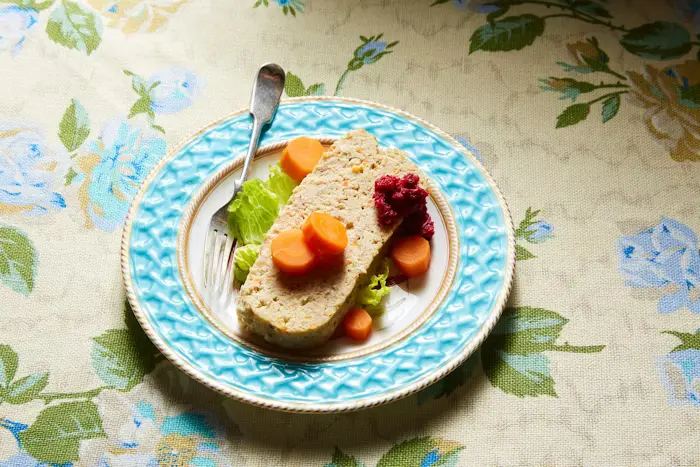
The original gefilte fish recipe in Liz Galst’s family called for two pounds of pike and one pound of whitefish. As a lifelong environmentalist, Liz updated it to use more sustainable fish: arctic char and farmed striped bass. She recommends a ratio of two parts fatty fish (like arctic char) to one part lean fish (such as farmed striped bass). Because arctic char has an orange hue similar to salmon, this gefilte is slightly more blushed than the classic one. For those who love a Jell-O-like  stock with their gefilte, note that in this recipe the stock does not fully set. 

Ask your fishmonger to grind the fish and reserve the bones and head for your poaching liquid. If they are unable to grind it, request that they filet the fish and remove the skin, still reserving the bones and head. To grind the fish at home, cut the fillets into chunks and process them in a food processor until very fine.

The gefilte fish needs to chill overnight, so prepare this recipe at least one day in advance and up to three days ahead.

Read more about Liz’s story in “Writer Liz Galst Is Who She Is Because of Gefilte Fish

Ingredients

For the poaching liquid:

  • Fish bones and heads
  • 4 medium carrots, cut into large chunks
  • 2-3 yellow onions, sliced
  • 1 celery root, peeled and cut into large chunks
  • Kosher salt
  • Freshly ground black pepper

For the fish patties:

  • 2 pounds ground arctic char
  • 1 pound ground striped bass
  • 2 eggs
  • ¾ cup matzah meal
  • ⅓ cup finely grated carrot 
  • ⅓ cup finely grated onion
  • 2 tablespoons kosher salt
  • Freshly ground black pepper
  • 6 tablespoons cold water, plus more as needed
  • 2 large carrots, sliced into ¼-inch coins
  • Chrain (prepared horseradish), for serving
AppetizersKosher for PassoverPassover Rosh HashanahWestern Europe

Preparation

  • Step 1

    Thoroughly rinse the fish bones under cold running water, removing any traces of blood. Place the bones in a stockpot and cover with water. Bring the pot to a simmer over high heat, then strain out the bones and discard the water. Wash the pot before proceeding.

  • Step 2

    Return the fish bones to the pot, add the carrots, onion, and celery root, and cover with fresh water. Bring to a gentle simmer over high heat, skimming any foam or impurities that rise to the surface. Reduce the heat to medium-low and simmer for 45 minutes. Strain out the solids and discard them. Return the poaching liquid to the pot. Set aside.

  • Step 3

    Meanwhile, combine the fish, eggs, matzah meal, grated carrot and onion, salt, and pepper to taste in a food processor. Begin processing, gradually adding cold water 3 tablespoons at a time until the mixture becomes smooth and uniform. Continue processing and adding water as needed until the mixture is uniform and gelatinous. 

  • Step 4

    Return the poaching liquid to a medium-high heat, add the carrot coins and bring to a gentle boil. Season with salt and pepper to taste.

  • Step 5

    Using wet hands, form the fish mixture into oval patties, roughly ¼ cup each, and carefully slide them into the pot. Bring the liquid to a gentle boil, then reduce the heat to a very low simmer. Partially cover the pot and poach for about 30 minutes, until the gefilte fish is pale and the carrots are tender. Remove from the heat and let cool for 30-45 minutes.

  • Step 6

    Transfer the gefilte fish and carrots to a container and pour the poaching liquid over them to cover and refrigerate overnight. 

  • Step 7

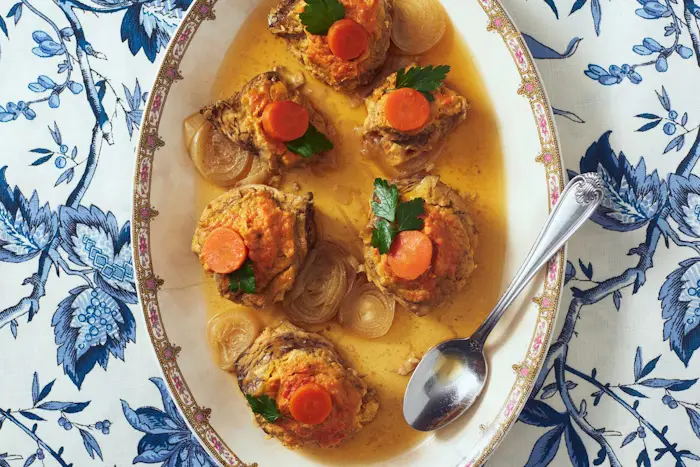
    For serving, arrange the gefilte fish on a platter, placing one carrot ring on top of each patty. Serve cold or at room temperature with a side of chrain (prepared horseradish).