When JFS culinary manager Talya Avisar learned of a Bukharian Shabbat dish in her fiance’s family she set out to master it, seeing it as an important step to becoming part of the family. Here, she tells us the story in her own words.
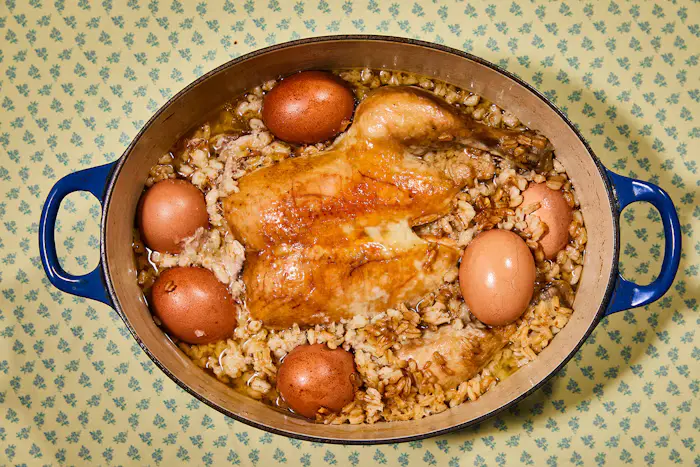
My fiancé Dean shoved his phone into my hand, showing me a message in his family’s WhatsApp group. It was a picture of a rich-looking rice stew, served with brown eggs, along with his dad Jeremy’s instructions for how to make the dish. I scrolled down and saw that his mom, Laura, had added, “Dad wants to know if Talya will put him on the website.”
Feeling the weight of responsibility, I instantly started interrogating Dean about the dish and its origins. I discovered that osavo, or oshsavo (osh means rice), is a Bukharian hamin — an overnight dish cooked on Friday night and eaten for lunch on Shabbat. It consists of caramelized grated carrots and onions, cubes of meat, dried fruit (prunes, in this case), and rice. Overnight, the rice gets soft and porridge-like and develops a charred, crispy bottom, which is everyone’s favorite part. Jeremy comes from a line of Bukharian men who love to cook, and this is one of his staples.
Before bringing the recipe to the JFS test kitchen, I knew I first had to make it at home. In a way, it symbolized stepping into this family and becoming a part of it.
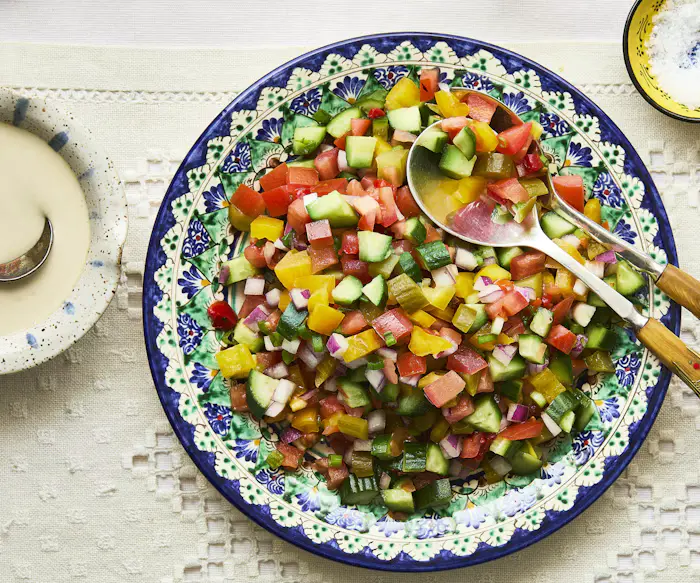
Fittingly, it was a very cold weekend (the only hamin-appropriate weather), and we invited friends over (this really isn’t a two-person dish). Unlike when I officially test a recipe, I didn’t follow the instructions religiously; I felt I had to rely on intuition and instinct and cook like a grandma for this to succeed. The osavo cooked all night, smelling almost too good to let us sleep. To serve with it, Dean made his dad’s famous salad of finely chopped vegetables with pickles and roasted peppers.
The osavo came out rich, comforting, and delicious, and we all ate a little too much of it. After lunch, Dean sent a photo to the family WhatsApp. When his dad called and declared that it “looks perfect” and asked whether we had taken the obligatory “shloof” — the inevitable post-hamin nap — I knew I had succeeded.
Cooking note: To ensure the osavo doesn’t dry out while cooking overnight, place a piece of parchment paper directly over the rice, then seal the pot tightly with a lid before putting it in the oven. To do this, cut out a circle of parchment paper to match the diameter of your pot.
Read more about Jeremy and Dean’s family in "the Bukharian dish that’s perfumed shabbats for generations" and try his recipe for chopped salad with pickles and roasted peppers.