Shared by Brigitte and Matan Choufan


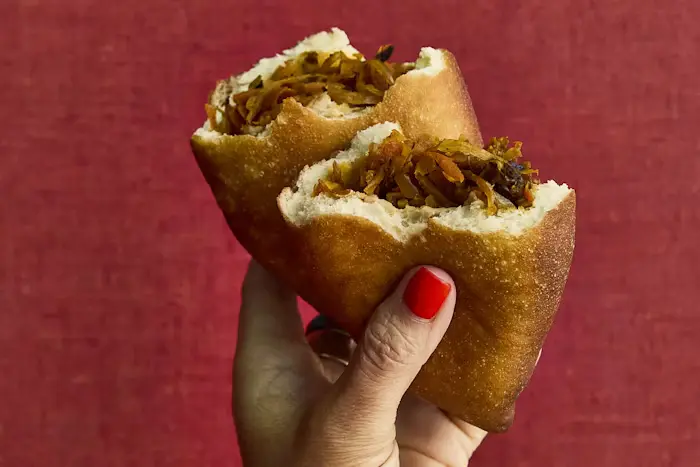
When Brigitte Choufan was growing up in Tunisia in the late 1950s, Jewish street vendors stuffed golden brown pillows of fried dough with tuna, fiery harissa, eggs, and potatoes to make the beloved local sandwich, fricassé. It was also served at picnics, henna parties, bar mitzvahs, and other gatherings.
Brigitte’s family moved to Paris when she was 10 years old and embedded itself in the close-knit Tunsiaian Jewish community. On the weekends, friends and neighbors would meet up for an apéritif with glasses of Boukha, a Tunisian spirit made from figs, and snacks of anchovies, tuna, and nuts. And, on Sundays, Brigette’s mom Fortuna would fry fricassé; it was a celebration.
A generation later, her son, Matan, grew up in Eilat with his other grandmother, Yasmina, frying fresh fricassé for large family gatherings on the beach for Independence Day. Even with 29 grandchildren, Yasmina never forgot to make a few without tuna for Matan and his brothers who didn’t like fish when they were kids.
Brigitte has taken over the fricassé duties in the family, traveling from Eilat to Tel Aviv to fry the dough at her sons’ homes for Hanukkah. She likes to serve it deconstructed, so everyone can create their own sandwiches — however they like the fricassé.
Cooking note: The Tunisian sandwich has many components, but most can be prepared ahead of time. If you plan well, by the time the fricassé rolls come out of the oil, all that’s left to do is assemble the sandwiches. The harissa and tirshi (pumpkin dip) can be made a day in advance, and while the fricassé dough is rising, you can boil the potatoes and eggs, dice the preserved lemons, and drain the tuna so everything is ready to go.
The sandwiches are best enjoyed fresh and warm, but they can also be assembled a few hours ahead if you’re taking them on a picnic or to the beach.
Brigitte and Matan Choufan served this recipe at Generations, an event series co-hosted by The Jewish Food Society and Asif: Culinary Institute of Israel, our partners from 2021 to spring 2026. Cafe Asif remains open.
In the bowl of a stand mixer fitted with the dough hook, combine the salt, flour, yeast, and sugar and mix on low speed. Add the egg and increase the speed slightly. With the mixer running, add the oil, then gradually pour in the water. Knead on medium speed for 10–12 minutes, until a soft and slightly sticky dough is formed. If the dough feels dry, add 1–3 tablespoons of water, 1 tablespoon at a time and continue kneading until fully incorporated.
Using your hands, shape the dough into a ball and place it in a large, lightly oiled bowl. Cover with plastic wrap and let rise in a warm place until doubled in volume, about 1–1½ hours.
Punch down the dough and transfer it to a lightly floured work surface. Divide it into 10–12 equal pieces, reserving a small piece of dough to test the oil temperature later. Shape each piece into a ball and using a rolling pin, roll each ball into an oval shaped disc, about 4 inches long, 2½ inches wide and 1 inch thick. Arrange the ovals on a well-floured sheet pan, dust the tops lightly with more flour, and cover with a towel. Let rise for 30 minutes.
While the dough is rising, heat 1 inch of oil in a wide sauté pan over medium heat. The oil should be hot, but not smoking, about 350°F. To tell if the oil is hot enough, add the small piece of dough you set aside earlier. If it immediately floats to the surface and gentle bubbles form around it, the oil is at the right temperature. If it sinks, the oil is not yet hot enough. You can add a piece of carrot to the oil at this stage to help keep the oil clean while frying.
Very gently transfer the proofed rolls to the hot oil using your hands, being careful not to deflate them or burn yourself. A floured offset spatula can also be helpful for transferring the rolls. Fry in batches of 2–3 at a time to prevent the oil temperature from dropping. Cook for 4–5 minutes per side, until golden brown. Transfer to a paper towel-lined sheet pan to drain. The buns will continue to cook slightly after they are removed from the oil, so let them cool for a few minutes before assembling the sandwiches.
To serve: Using a serrated knife, make a slit along the side of the rolls. Spread an even layer of tirshi and harissa on the top and bottom of the roll and then fill with cooked potato, hard-boiled egg, olives, fish, and preserved lemon to taste.