Shared by Odelia Benarroch


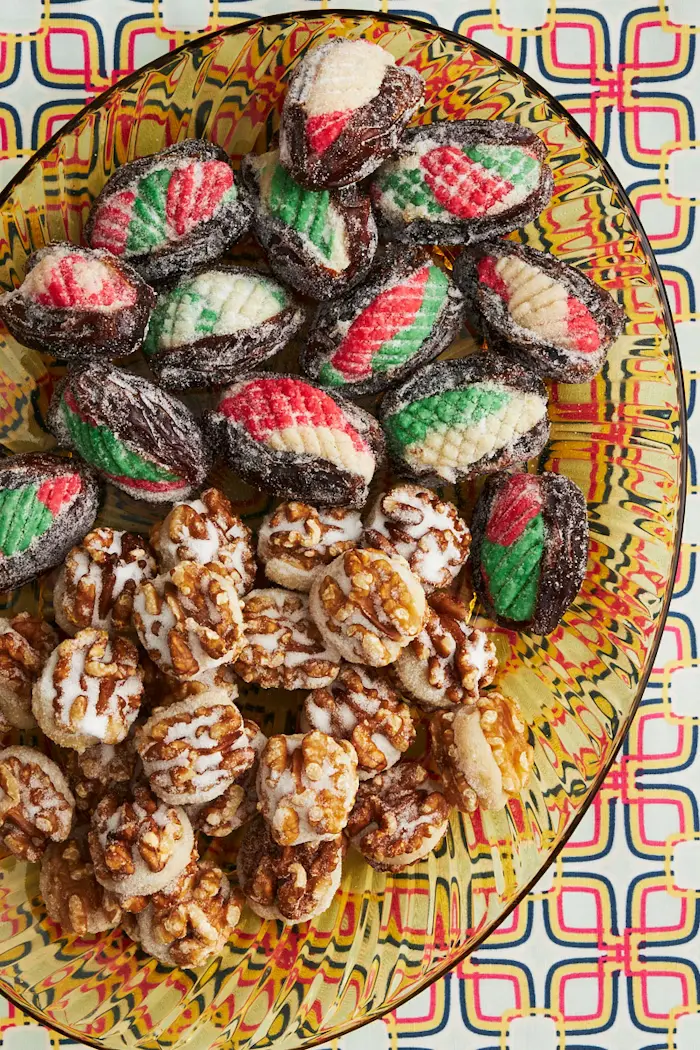
Odelia Benarroch and her grandmother Ethelyn spoke Hebrew with one another, but Spanish was often sprinkled in when they discussed food. “Some things were just in Spanish for her,” Odelia, who is a film editor, shares. Ethelyn would make empanadas, the egg and potato dish tortilla Española, a Sephardi eggplant casserole called almoronia, and quesiño, the family name for these marzipan treats. It means small cheese in Spanish, and Odelia thinks it comes from queso de almendras, a cheese made from almonds.
Ethelyn was raised in Tetouan, a city in northern Morocco along the Mediterranean coast, which was a Spanish protectorate for much of the early 20th century. The Sephardi Jewish community, which migrated there during the Inquisition, spoke Spanish as well as Haketia, a Jedeo-Spanish language that developed in parts of North Africa. “When the Spanish coloniz[ers] came in the 19th century, they were surprised to see that there were people speaking this really weird old Spanish,” Odelia adds. In 1972, Ethelyn moved to Israel.
Whenever she would tell Odelia about her wedding, Ethelyn would share stories of the quesiño that was served. It was part of special occasions like henna ceremonies before a wedding and Purim. This recipe has been passed across blood lines. It originally came from Ethelyn’s Portuguese sister-in-law, who the family called Tita Luna, and later, Ethelyn shared it with her daughter-in-law Danielle, Odelia’s mother. In the family, it’s made with an electric grinder called Uno, Dos, Tres. And Odelia remembers that there was a gentle competition in the family over who prepared the best version, each hand seemed to leave its touch, producing an ever so slightly different quesiño.
Odelia’s mother also likes to add the orange flavored liquor Grand Marnier, a nod to her upbringing in Paris. She and Odelia prepared the quesiño for Purim every year — filling half with little dabs of sunny homemade lemon curd and dunking the other half into chocolate. Her grandmother would check in on the process, asking about each step. “She would keep an eye on everything — always,” Odelia says, laughing.
They would wrap up plates of the treats in cellophane with a little bow and deliver their Mishloach Manot (holiday gifts) to friends. “As a child, the whole back seat of the car was full,” Odelia adds.
Cooking note: The quesiño can be filled with lemon curd or dunked into chocolate. If you want to make the chocolate version, see the variation at the bottom of the recipe.

Prepare the lemon curd: In a small saucepan, combine sugar and water. Bring to a boil over medium heat, stirring until the sugar dissolves, about 2 minutes. Remove from the heat and let cool for 5 minutes (the syrup should be warm, not hot).
In a small bowl, whisk together the egg yolk and lemon juice until smooth, then pass the mixture through a sieve.
Add 1 tablespoon of the sugar syrup to the egg yolk mixture and whisk, then pour the egg yolk mixture into the saucepan with the remaining syrup.
Return the saucepan to low heat and cook, whisking constantly, until the mixture thickens to a custard-like consistency, about 5–8 minutes. Do not let it boil.
Transfer the curd to a bowl, cover with plastic wrap pressed directly onto the surface to prevent a skin from forming, and let it cool to room temperature, about 15 minutes.
Prepare the marzipan: Place 2 cups of blanched almonds in a food processor and pulse 8-10 times, until very finely ground and sandy.
Add 1 cup powdered sugar and pulse 4-6 more times to combine.
Add the lemon zest, 1 egg white, Grand Marnier, and salt. Process until a smooth, pliable dough forms, about 30 seconds.
Roll the marzipan into small, cherry tomato-sized balls (about ½ tablespoon each), place on a plate and cover with plastic wrap.
Working with one ball at a time, leaving the rest covered, use your pinky or the wide part of a chopstick to make a well in the center of each marzipan ball. Use a small spoon to fill each well with about ¼ teaspoon of lemon curd. Gently pinch the marzipan closed and reshape into a ball. Roll each ball in powdered sugar and place into a mini candy liner. Repeat with the remaining balls and place in an airtight container in the fridge.
Keep marzipan in an airtight container in the fridge for up to 4 days.
Variation: To make the chocolate covered marzipan, prepare the marzipan (steps 7–10), omitting the lemon zest. Place 6 oz of dark chocolate (60%-70%) in a small microwave-safe bowl or mug. Microwave in 30-second intervals, stirring between each, until fully melted and smooth (1½–2 minutes total). Lower a marzipan ball into the melted chocolate and, using a fork, roll it around until fully covered. Lift the ball with the fork, gently shaking to let excess chocolate drip off. Transfer to a sheet pan lined with parchment paper and repeat with the remaining balls. Refrigerate until set, about 45–60 minutes. Then transfer to mini candy liners and place in an airtight container for up to 4 days.