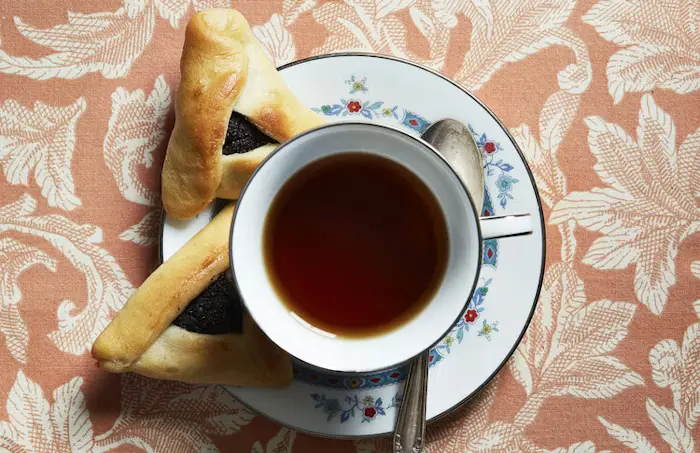
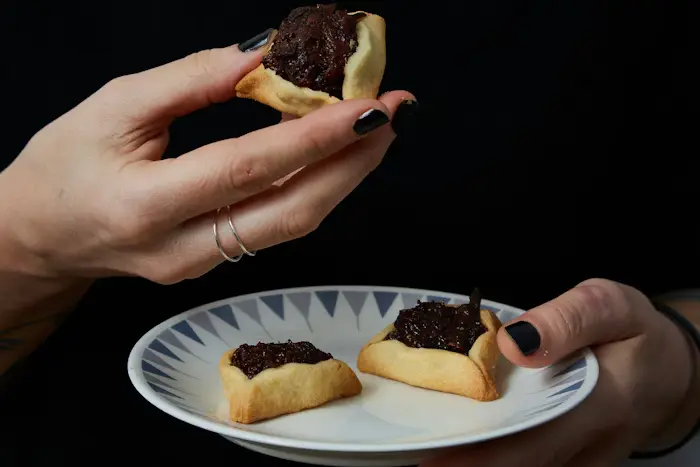
Every fall, Maya Tsameret’s family swapped sleep one night for shifts in their backyard where they took turns stirring a large pot of plums with a stick as the fruit cooked down into a sweet paste called powidl. They gave away jars of it, but always stashed some for Purim when they mixed the powidl with chopped nuts and orange zest for their hamantaschen filling. Unlike most recipes for the triangular cookies, the crust in their family is lightened with yeast and enriched with both butter and sour cream.
“When I asked her about it, she told me that this was — to her knowledge, at least — a recipe that was specific to Bessarabian Jews,” Ohad shares, referring to Jews from a historically contested region that overlapped with much of modern Moldova including Orgeyev (the Jewish name for Orhei), where Maya was raised. Bessarabia was taken over by the Soviets in 1940, so Maya (who was born Marlena) speaks Yiddish, Romanian, and Russian. And, in the mid-1970s, she received permission to leave the USSR for Israel with her daughter Aviva, Ohad’s mother.
For a time, the recipes Maya cooked from home like chopped liver with lots of black pepper and eggplant salad loaded with garlic arrived handwritten, along with letters from her own mother who remained in Moldova for a few years. Half a century later, they are marked with oil stains, but still part of her life.
For Purim, Maya continued to bake her mother’s hamantaschen for decades, making a large Tupperware box full of them for Ohad’s family. But she swapped the night shift of stirring plums for store bought plum butter and when she tired of folding the hamantaschen, she used the recipe to make a roulade with the same ingredients. At 82 this month, she no longer has the energy to make the cookies, but she worked with someone to help her bake a batch several years ago.
“That was the last time I had them,” Ohad shares — until he helped us document this recipe. He isn’t willing to let it be lost to time. “I totally take responsibility for this,” he adds.
Cooking notes: This recipe calls for powidl, a Central European plum butter, that’s made by slowly cooking plums for hours until thickened, without any added sugar. You can find it in specialty stores or online.
To prevent gluten from developing, the dough was traditionally chopped with a cleaver rather than kneaded. This version uses a food processor to achieve the same effect.