Both of Julie Ebani’s Syrian grandmothers were good cooks, but “I don’t know if they were great cooks,” says the content creator and owner of Julie’s Market Cafe in Brooklyn. The level of their kitchen skills isn't what’s important to Julie. It’s that they gathered everyone around food. “I think that’s what I enjoy about cooking. I like keeping the family together,” she says.
Julie’s relatives, like much of her husband’s family, emigrated from Aleppo in the late 1920 and helped build a large and rich Jewish community in deep Brooklyn. “We’re very close, tight knit and a little bit segregated," she explains. “It keeps our community together.” Customs, religious practices, and dishes are shared throughout.
But, when Julie got married, she didn’t know how to chop an onion. Her mother Susie and her mother-in-law Linda taught her to make their community’s dishes. “My mother-in-law has a very strong Sephardic hand, and she is well known in my community as an amazing Syrian chef,” she says. Julie also took culinary classes and developed a cooking style that’s both rooted in Syrian tradition and more contemporary cooking. “I like to bridge both worlds,” Julie says.
Today, the intergenerational duo creates cooking videos together on Instagram. “The modern and the traditional, I think that is what people loved and what people still enjoy,” she adds.
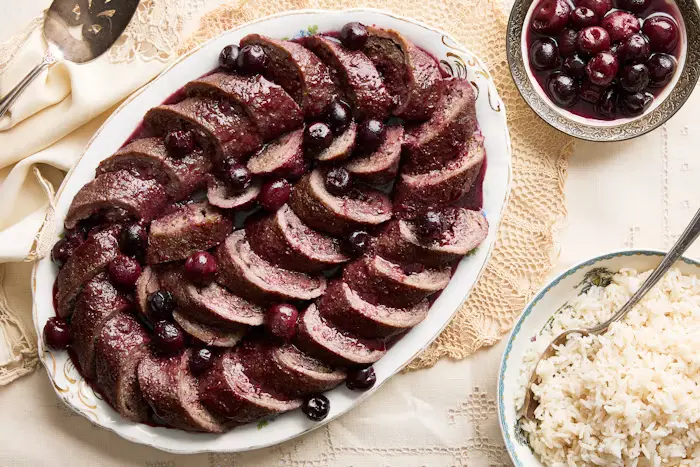
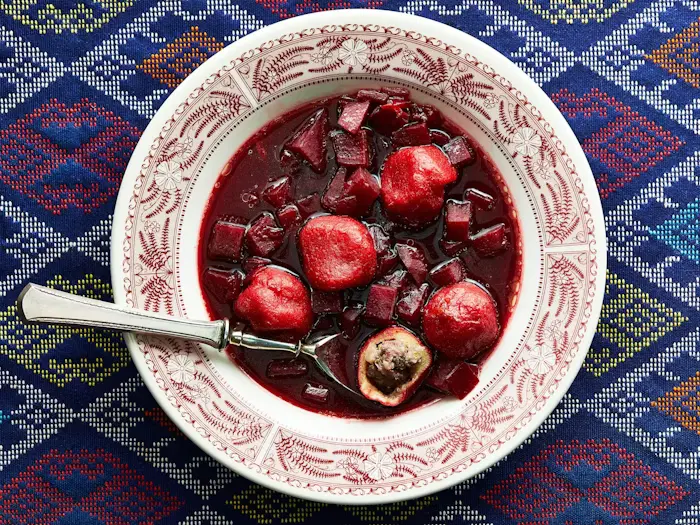
Together, they’ve shown followers how to make Shabbat rice, keftes, or meatballs in a spiced sauce, and kibbeh basha. A labor of love, the torpedo-shaped kibbeh is made from a dough of finely ground meat and rice, filled with tadbileh, a mixture of caramelized onions and seared ground beef seasoned with allspice. The kibbeh can be served in a mushroom sauce for a dish called kibbeh mushroom, but for Rosh Hashanah, Linda adds pomegranate seeds to the filling and simmers them in a cherry sauce to welcome a sweet new year.
Cooking note: Kibbeh dough is available at kosher Syrian butchers. We’ve also included a recipe from Poopa Dweck’s “Aromas of Aleppo: The Legendary Cuisine of Syrian Jews.” The consistency should be like soft play-doh. You can use a coffee grinder to grind the rice at home. Grind it as finely as possible; the texture should be similar to almond flour. When working with kibbeh dough, keep a small bowl of neutral oil near your workspace to dip your fingers in as needed. The dish is served atop white rice, which soaks up the sauce.
Julie makes this cherry sauce with canned cherries, but you can also use frozen or fresh cherries. Her original recipe includes sweet chili sauce, though it’s also excellent without it.